From Ontario's "Learning for All" to Modali's Neuro-Psychometric Engine
The 2013 Provincial Foundations, the 4 Critical Gaps, and the Empirical Science Behind Every Addition
Explore the complete intellectual, neuropsychological, and statistical lineage of the Modali platform. Discover how Ontario’s landmark 2013 special education framework was synthesized with Harvard’s UDL 3.0, John Sweller’s Cognitive Load Theory, Jim Cummins' linguistic safeguards, and standardized \(Z\)-score psychometrics.
1. Illustrated Conceptual Roadmap: From 2013 Policy to Modern AI-Profiling
A visual continuum tracing the transition from qualitative, paper-based forms to real-time, multi-axis neuro-psychometric algorithms.
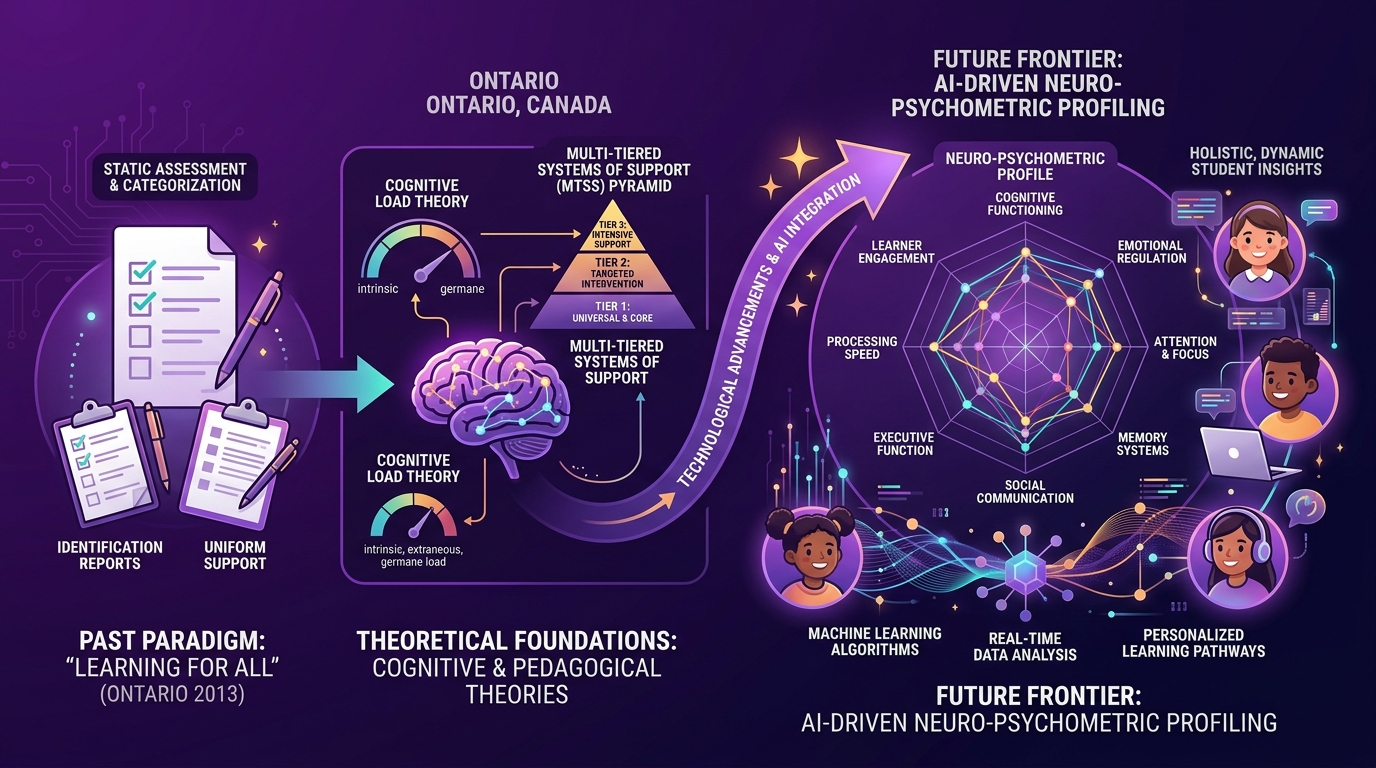
Past Paradigm (Ontario 2013)
Static assessments, manual paper checklists, and anecdotal identification reports. While pioneering the Class Profile (Appendix A), it lacked quantitative precision and relied on subjective educator estimation.
Theoretical Foundations
Injection of John Sweller's Cognitive Load Theory (regulating intrinsic, extraneous, and germane load) and the Multi-Tiered System of Supports (MTSS) 3-tier prevention pyramid to eliminate wait-to-fail models.
Future Frontier (Modali Engine)
Real-time 13-subscale radar profiling, automated \(Z\)-score normalization (\(\pm 0.85\sigma\)), linguistic discrepancy isolation (\(\Delta_{\text{Lang-Cog}}\)), and 62 programmatic UDL instructional strategies.
2. Quantitative Comparison: Qualitative Observation vs. Modali Radar
Observe the difference between the 2013 qualitative tri-category assessment and Modali's 13-subscale standardized radar with \(\pm 0.85\sigma\) bell curve cutoffs.
Modali 13-Subscale Radar Profile
Student Profile vs. Empirical Cohort Benchmark (\(\mu_k\))
In the 2013 Ontario form, a teacher might write "Good at hands-on tasks, struggles in language." Modali replaces this with 13 radial mathematical vectors, instantly isolating whether a language struggle is verbal encoding (\(VER\)), auditory reception (\(AUD\)), or linguistic English barrier (\(\Delta_{\text{Lang-Cog}}\)).
Standardized Z-Score Bell Curve (\(\mu=0, \sigma=1\))
Mathematical \(\pm 0.85\sigma\) Clinical Decision Boundaries
3. What Was Originally Derived from Ontario's Learning for All
Published in 2013 by the Ontario Ministry of Education, this policy document set the international gold standard for inclusive classroom practices.
What Modali Preserved & Adopted
- "Fairness is not sameness": The fundamental axiom that providing every student with identical materials creates inequity; students require differentiated pathways to demonstrate proficiency.
- The Class Profile (Appendix A): A single operational document synthesized before the semester begins, allowing educators to map cohort patterns and bake accommodations into primary lesson planning. View Blank Form & Exemplar →
- The Student Profile (Appendix B): A cumulative diagnostic record tracing an individual student's developmental strengths, environmental triggers, and effective instructional accommodations. View Blank Form & Exemplar →
- Assessment FOR & AS Learning: Viewing diagnostic profiling not as high-stakes judgment, but as formative feedback for teachers and self-regulatory reflection for students.
- Professional Learning Communities (PLCs): Structuring grade-level educator teams around empirical student data rather than administrative busywork.
The 4 Bottlenecks of the 2013 Manual Era
- Subjective Teacher Guesswork: Appendix A was a blank paper template. Teachers filled it out using anecdotal impressions, leading to unconscious confirmation bias and inconsistent IEP entries.
- The VAK "Learning Styles" Fallacy: Classrooms frequently misapplied UDL by pigeonholing children into rigid, debunked categories (e.g. "Visual learner only"), ignoring multimodal sensory integration.
- Extraneous Cognitive Load Overload: Without developmental text-level adapters, diagnostic prompts overwhelmed students with weak reading comprehension, confounding reading ability with non-verbal intelligence.
- EAL / ELL Misclassification Risk: Multilingual learners with high cognitive potential who struggled with English vocabulary were routinely misclassified as learning disabled.
Ontario Profiling Forms & Clinical Exemplars
Explore the official blank templates and fully completed exemplars used by Ontario educators under Learning for All (2013) and Ontario Regulation 181/98.
Individual Student Profile Form
Comprehensive diagnostic record incorporating 8 information sources (OSR, IEP, observations, diagnostic scores, ELL STEP level), 3-column strengths and needs findings, and a full UDL planning matrix.
Class Profile Matrix Form
Cohort-wide panoramic matrix operationalizing "Fairness is not sameness." Maps all students across 6 columns to establish a class-wide UDL environmental blueprint before the semester begins.
4. Where the Additions Were Gotten From: The 7 Empirical Foundations
Every formula, button, subscale, and algorithm in Modali is directly anchored to peer-reviewed neuropsychological and cognitive research.
1. Universal Design for Learning (UDL 3.0)
Mapped to the tripartite neurological brain architecture:
- Recognition Networks (Occipital/Temporal): Representation (`VIS`, `AUD`, `KIN`, `VER`, `LOG`, `SPA`).
- Strategic Networks (Frontal/Parietal): Action & Expression (`APP`, `VER`, `SPA`).
- Affective Networks (Limbic System): Engagement (`INTER`, `INTRA`, `ENV`, `GSTI`, `SMMR`, `STSR`).
2. Cognitive Load Theory (CLT)
Addresses the human cognitive architecture: working memory capacity is strictly limited (\(7 \pm 2\) or \(4 \pm 1\) chunks). Modali protects working memory from extraneous load:
- The 🪄 Simplify Button: Strips extraneous linguistic syntax without diluting construct validity.
- 4 Grade Bands: Text difficulty tuned to K–3, 4–6, 7–8, and 9–12 readability.
- Neural TTS Rate (\(0.85\times\)): Prevents auditory working memory bottlenecking.
3. Multi-Tiered System of Supports (MTSS / RTI)
Replaced the historic "wait-to-fail" discrepancy model with proactive early screening and automated tier classification:
- Tier 1 (\(TII \le 2.00\)): Universal Core instruction (80–85% cohort).
- Tier 2 (\(2.00 < TII \le 3.50\)): Targeted Small-Group Pods (10–15%).
- Tier 3 (\(TII > 3.50\)): Intensive In-School Referral (1–5%).
4. BICS vs. CALP & Linguistic Discrepancy
Proved that acquiring Cognitive Academic Language Proficiency (CALP) requires 5–7 years, leading standardized tests to misdiagnose bilingual and immigrant students:
When \(\Delta \ge 1.20\), Modali legally flags an EAL Language Acquisition Barrier rather than a learning disability, safeguarding diverse student records.
5. Dual-Coding & Pashler's Debunking of Styles
Pashler et al. conclusively proved there is no empirical validity to treating students as locked into single-modality "learning styles." Paivio proved human memory operates via nonverbal and verbal dual systems.
- Multimodal Sensory Score (MMS): Triggers whenever \((S_{(1)} - S_{(2)}) < 0.30\), celebrating multimodal cognitive blending.
- Strengths Anchoring: Uses high visual or kinesthetic channels to anchor abstract verbal tasks.
6. Executive Function & Self-Regulation
Isolates the 3 executive mechanisms that govern whether a child can deploy cognitive assets in dynamic classroom settings:
- Goal Setting & Task Initiation (`GSTI`): Overcomes procrastination and initiation friction.
- Self-Monitoring & Regulation (`SMMR`): Pacing, impulse control, and metacognitive error checking.
- Scaffolding Receptivity (`STSR`): Vygotskian Zone of Proximal Development response to external scaffolds.
7. International Statutory Compliance & Accreditation Standards
Ensures that diagnostic outputs directly produce the evidentiary artifacts legally mandated by global school inspections:
5. Feature-by-Feature Evolution Matrix
| Feature / Dimension | Ontario "Learning for All" (2013 Original) | Modali Neuro-Psychometric Engine |
|---|---|---|
| Assessment Instrument | Informal observation, past grades, teacher notes. | 100 standardized Likert indicators across 8 Developmental Pillars. |
| Psychometric Norms | None. Subjective ratings without population baselines. | Standardized \(Z\)-Scores (\(Z_k\)) calibrated to cohort norms (\(\mu_k, \sigma_k\)). |
| Strengths & Needs Cutoffs | Arbitrary teacher judgment. | Empirical \(\pm 0.85\sigma\) thresholds (\(\alpha \ge +0.85\), \(\delta \le -0.85\)). |
| Sensory Processing Model | Risk of rigid VAK silos (Visual / Auditory / Kinesthetic). | Multimodal Sensory Score (MMS) with Paivio Dual-Coding cross-talk. |
| Cognitive Load Regulation | Uncontrolled prompt reading complexity. | 🪄 Simplify engine, 4 grade-band calibrations, and \(0.85\times\) neural TTS. |
| EAL / ELL Equity | No formula to isolate language proficiency from disability. | \(\Delta_{\text{Lang-Cog}} \ge 1.20\) discrepancy safeguard preventing misdiagnoses. |
| Intervention Tiering | Manual nomination by classroom teacher or committee. | Automated Tiered Intervention Index (\(TII\)) driving Tier 1/2/3 placement. |
| Class Matrix (Appendix A) | Paper/Word document requiring hours of manual synthesis. | Real-time dynamic matrix updating instantly upon student submission. |
| Student Profile (Appendix B) | Static paper IEP attachment. | Interactive 13-axis radar chart with personalized study habits & PDF export. |
| Instructional Grouping | Ad-hoc seating charts or arbitrary friendship pods. | Algorithmic Heterogeneous Inquiry Teams & Homogeneous Tier Pods. |
6. Scholarly Literature & Policy Citations
Experience the Synthesized Engine Live
Take the 100-indicator diagnostic to generate your own personalized Appendix B psychometric radar and explore your classroom's live Appendix A matrix.